The Indiana Fever step into the Fire Pit for the first time, and they helped fill the stands for Portland’s second sell-out of the season. Lots of whistles, a mid-court confrontation, two successful coaches challenges, and a blowout win spoiled the local Fever fans’ night, and the Fire completed what may have been their best game yet.
Let’s talk about it.
Four Factors
Team | Points | Pts/Poss | eFG% | TOV% | OREB% | FTA Rate |
Portland | 100 | 1.22 | 57.9% | 15.0% | 35.3% | .286 |
Indiana | 84 | 1.04 | 45.7% | 22.5% | 40.0% | .603 |
These are an old set of standardized “only stats that matter”. Here’s a fun explainer video from Molly Brown on Instagram, who is going to be a great follow for any fan of my writing here: https://www.instagram.com/reel/DXusixFkrAA/
Injuries
Portland | Indiana |
Karlie Samuelson (injury management) |
Brain Dump
Indiana fans travel. We knew this, but seeing it was a pleasure. Tons of families, young girls burgeoning into W fans, that part was great. But there were also a lot of single, older white dudes, and my first sighting of a Blue Lives Matter-esque tanktop in the arena, which is a style that can follow the Fever, unfortunately. Regardless of that, the vibes were great, especially after the first couple of minutes of the game.
I predicted after Friday’s Atlanta game that we might see more lineup changes, and we were hit with the most significant change of the season so far: Megan Gustafson would start the game in the place of Luisa Geiselsöder; Indiana was sharp to start the game, gaining an 8-2 lead and forcing one of the earliest timeouts that Fire coach Alex Sarama has called this season. After that timeout, Portland would start going on a run, gain the lead, and never give it back. The Fever had 5 turnovers and 8 fouls, helping the Fire get to a 29-15 lead at the end of the first quarter.
Caitlin Clark had 5 points and 3 assists after the first quarter, but also had 2 fouls and was pulled out of the rotation sooner than the Fever would have liked. She only scored 1 more point in the entire game, turning in one of the least impactful games I have ever seen her play. The Fire switched her onto the ball handler as frequently as they could, attacking her with drives that mostly led to a foul on her or a bucket. The Fire’s gameplan against Clark was solid, and the execution was excellent.
The first quarter set the tone for soft officiating: lots of foul calls on both sides, a ton of free-throws, teams were in the bonus every quarter, and the game took a long time to progress. The first three quarters, the Fire were energized, they were focused, they were sharp, and they defended. The Fever were none of those things.
Portland played their first zone, maybe only for a single possession, but I am always a fan of having the strategy available as a change-up. The Liberty fall into a zone occasionally, and it worked pretty well to confuse and slow the Fire’s offense in their games this season.
The Fire challenged two calls in the Fever game, and were successful on both! They challenge things frequently, and have had a high success rate on them. It’s genuinely a competitive advantage.
Emily Engstler is unshakable, properly responding to Indiana’s Sophie Cunningham “incidentally” hitting Emily in the face. Engstler had 4 steals, 2 blocks, two of the best passes I’ve seen her make this season, and 16 points, which is tied for her season high. Carla Leite had a career-high in assists (12) and 18 points, a great bounce back game after really struggling on Friday. Bridget Carleton was hitting her shots inside and out. Nyadiew Puoch was disrupting Caitlin Clark’s game, and added a lot that isn’t recorded on stat pages. Sarah Ashlee Barker continues to become a floor general in her bench minutes — they are running plays for SA, and through her.She had 15 points off the bench, and again had two of the five biggest shots of the night. Teja Oblak had a tougher game as she is learning the league and its contact levels and ref’ing styles.

from: OregonLive
Three Takeaways
This team is deep. It felt especially true in this game with the fact that Portland just swapped their starting center overnight and looked way better, and because the Fever, a projected top-4 team in the league, had seemingly no one to turn to when their starters didn’t seem to have it. Even last game, when Atlanta won by a healthy margin, the Dream starters played a ton of minutes. There are times when Portland’s bench is playing against the opposing starters, and it goes terribly for the Fire. But those moments are getting fewer and farther between, while other teams spend more time not developing their entire roster. The depth is quickly becoming a differencemaker for Portland, and no one else in the league is leaning quite so far into their reserves.
The Fire defense is legit. 8 steals, 5 blocks, 17 forced turnovers, and 84 points allowed to the highest-scoring team in the league. Emily Engstler has put herself on most pundit’s Defensive Player of the Year ballots for this first quarter of the season; Nyadiew Puoch has ruined the night of any elite point guard that has come to Portland; Bridget Carleton has great footwork and size and is an elite second option to guard an opponent’s best player, and is in the top 3 in the league for steals; SA is a fierce defender who you cannot outwork, and flies all over the court for defensive rebounds and steals. Meg Gustafson and Luisa Geiselsöder have just enough size, and plenty of grit, to battle in the post and take a beating and not give up too much room to anyone. The overall numbers aren’t great so far this season, but at their best, I think this is a top-5 defending team with almost no weaknesses.
This team responds to losses. The Fire are 4-0 after losses, beating New York, Connecticut, Toronto, and now Indiana. Three of those four are really good teams! This team has been great at correcting mistakes in-between games, which is a credit to the coaching staff as well. Coach Sarama, in the post-game press conference, talked about how big of a deal the first Indiana game was, and how that loss sparked some good changes for the team:
Rose-Colored Bucket-Getter of the Game:
Megan Gustafson (28.5 minutes, 22 points (8/8 shooting), 1 rebound, 0 assists, 0 steals, 1 block, 0 turnovers)
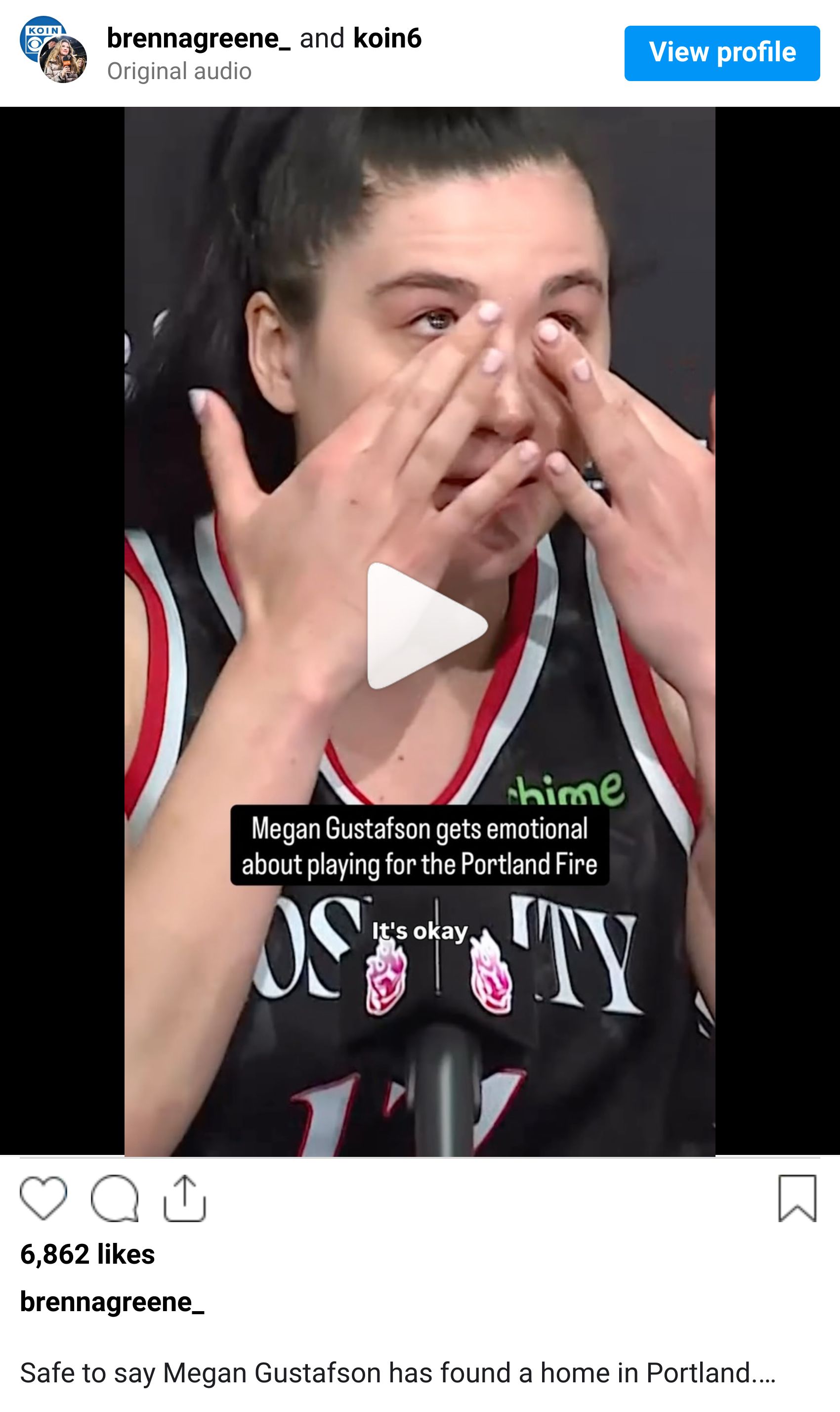
In her first start of the season, and just the 13th start of her career, Meg Gustafson popped off. She was already in the top 5 of efficient shooting in the league this season, which was a major factor in the decision to raise her into the starting five, and then she responds to the bigger role by not missing a single shot from the floor – she did, funnily enough, miss one of her six free-throws. She caught every ball that was thrown her way, she was stout on defense (though she got baited into a call or two by Aliyah Boston, an elite foul drawer), and she clearly gives her teammates a lot of energy. It was the right move by the coaching staff, and it was a beautiful performance from a veteran who feels valued for the first time in her career:
Wrap-Up
This was potentially the best game the Fire have ever played, and they did it in the second game of a back-to-back while making a change to their starting roster. Resilience, depth, a certified homecourt advantage, a grounding defense, a growing offense: Portland continues to prove that they are a threat to beat anybody in their first season.
The difficult stretch continues, with six more tough opponents in a row. But Atlanta and Indiana were two of the toughest, and splitting those games is a strong start. Coming up: Portland’s first-ever Commissioner’s Cup game, their first game against the 2025 expansion Valkyries, and their first-ever game in Ballhalla. It doesn’t get much tougher than that.
Have questions? Submit them through the link below, and I’ll answer them periodically!
Glossary
Points per Possession - how many points a team scores for every possession they have
Effective Field-Goal Percent (eFG%) - field goal percentage with weight added to three-point shots
Turnover Percent (TOV%) - percent of possessions that ended in a turnover
Offensive Rebound Percent (OREB%) - percent of a team’s own misses that they rebounded
Free-Throw Attempt Rate (FTA Rate) - how many free throws a team takes for each Field Goal attempted