The Portland and Seattle rivalry successfully reunited last night when the Fire flew to Seattle from their Eugene training camp and competed in the new franchise’s first-ever pre-season game, one filled with fouls, turnovers, three’s, and energy. Did I mention fouls?
Since it’s our first ever game here at Rose-Colored Buckets, we need to establish some stats and sections and features of a game recap. Below is what I have loosely planned so far, but please feel free to tell me what you are interested in seeing or learning about each game.
Four Factors
Team | Points | Pts/Poss. | eFG% | TOV% | OREB% | FT Rate |
Portland | 81 | 0.96 | 46.6% | 19% | 25% | 32.13 |
Seattle | 91 | 1.01 | 40.4% | 17.7% | 46% | 35.52 |
These are an old set of standardized “only stats that matter”. Here’s a fun explainer video from Molly Brown on Instagram, who is going to be a great follow for any fan of my writing here:
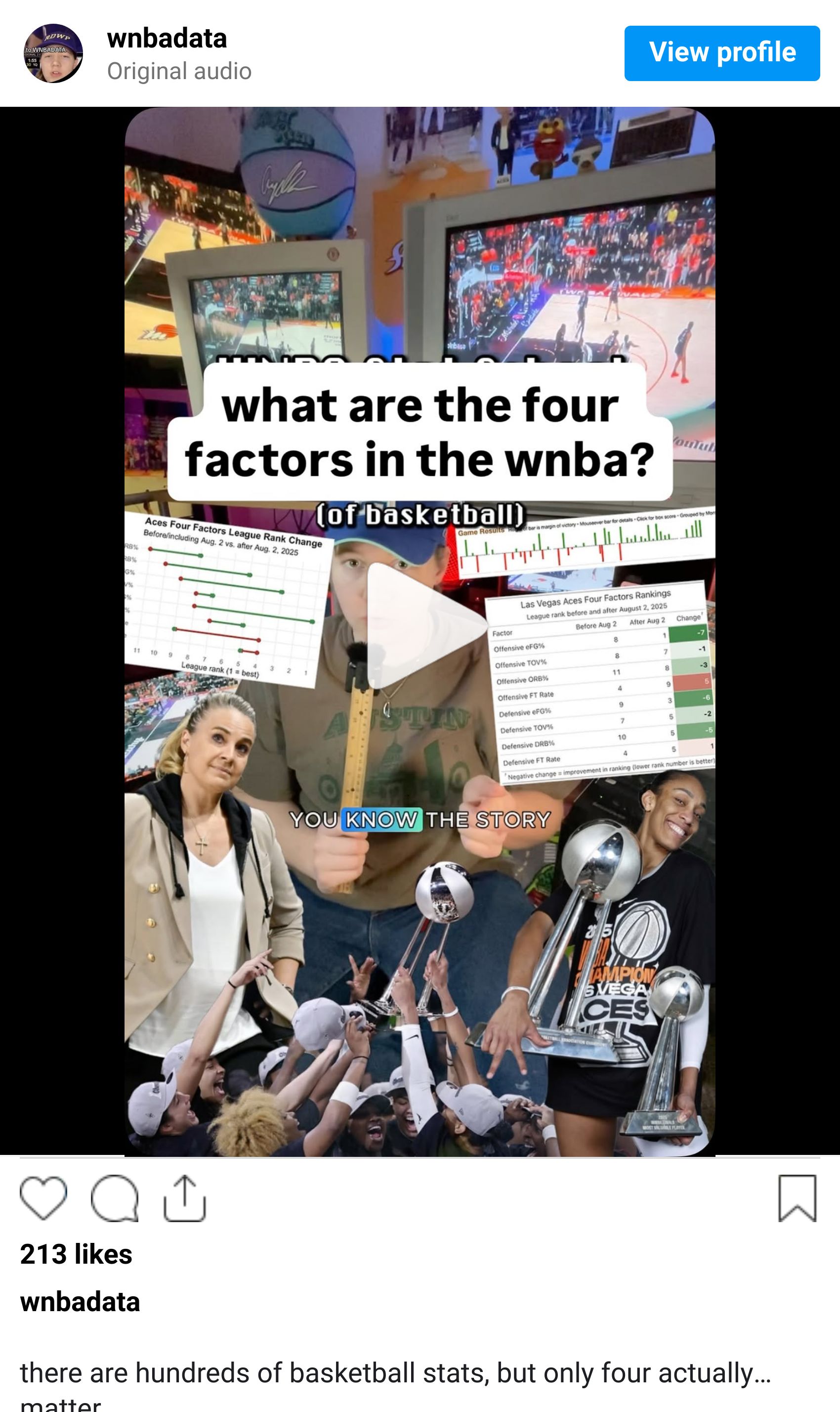
In my mind, the story of this first game was rebounding. Seattle dominated the glass, earning 11 more rebounds total and 9 more offensive rebounds than Portland. This disparity led to Seattle having 15 more shot attempts in the game than Portland did. That is a wild number! Can you imagine starting a basketball game in which your opponent gets to have 15 shots in a row, and then you get to start playing back and forth? Seems like a tough way to win!
There are other ways to earn more shot attempts than your opponent, of course: winning jump balls, having less turnovers, free-throw differences, end-of-quarter luck, etc. The free-throws, while way too frequent for one game, were even: 41 for the Fire, 42 for the Storm. The turnovers were dead even, 16 per side.
Officially speaking, via math, Seattle had 90 possessions in this game, and Portland had 84.
The game was functionally incredibly close the entire way. I would credit the difference on the scoreboard to Seattle’s Dominique Malonga and Zia Cooke: Malonga had 11 rebounds, including 6 offensive rebounds, and Zia Cooke caught fire in the second-half, scoring a total of 19 points in 18 minutes off the bench, including some dagger three’s (she was 4-9 from distance).
Portland even shot better than Seattle, which helps illustrate the importance of the possession game. You can be sharp when you shoot, but you can’t let the other team shoot more than you, or shoot higher quality shots than you.
Three Takeaways
Portland could be at a rebounding deficit all season. They had to play one of the biggest and most athletic players on the planet in Dominique Malonga, but the Fire’s current center rotation of Luisa Geiselsöder and Megan Gustafson don’t have the same combination of size and speed that Seattle and other teams frequently have. The Fire are going to need to lean into scrappiness, energy, and team rebounding to make sure that these differences in roster don’t become a problem on the glass.
Portland is clearly building slowly. Their offensive playbook is knowingly, intentionally shallow, which threw players into the game and asked them to figure it out, to attack when they could, to use their super-powers as they saw fit. There were some great off-ball screens that led to the Fire’s best three-point shots of the night, but the game was mostly pick-and-rolls and tough drives into traffic. The Fire earned a lot of free-throws, which is a type of shot they will prioritize, and mostly took shots in the paint (close to the rim) or from three. They also found some success in transition, as their roster construction of forwards who can almost all dribble well showed the team’s ability to rebound and run. This team can push the pace no matter who has the ball, which is going to be a strength.
This is a dynamic group of players. Six of their ten active players can handle the ball, can drive, can pass; all of their bigs can shoot from deep, and outside of their two lead guards in this game, Carla Leita and Jordan Harrison, they have pretty good size and length at every position. And those two potentially undersized guards are strong and scrappy. Coach Alex Sarama said in the post game press conference that their defense is looking to do one thing: disrupt. I think this team is very capable of disrupting most rosters.
Rose-Colored Bucket-Getter of the Game:
Emily Engstler (17 minutes, 5 points, 7 rebounds, 2 assists, 2 steals, 3 blocks)
Engstler has been a vocal leader in the early stages of this Fire team’s training camps, and immediately played like a leader in this first game. Many plays that came after time-outs or breaks involved getting her the ball and letting her make something happen.
Her energy and effort were a boon to the overly-simplified Fire playbook, and while she only scored 5 points, she also: hit a three, took in 7 rebounds (tied for the team high in limited playing time), threw two of the nicest passes of the game, and earned two steals and swatted three shots. When bigger volume scorers join the Fire team soon (Bridget Carleton landed in PDX today 👀), Engstler’s game tonight is one they will want every single night.

from: Portland Fire instagram
I have so many more thoughts, and I’ll share one on each active player in another piece hopefully coming before pre-season game #2, but I’ll cap them here for now.
This was a great, if choppy, game of basketball, and I’m glad the season has officially soft launched.
Talk to you soon, or better yet, see you at the Moda Center on Sunday.
Glossary
Points per Possession - how many points a team scores for every possession they have
Effective Field-Goal Percent (eFG%) - field goal percentage with weight added to three-point shots
Turnover Percent (TOV%) - percent of possessions that ended in a turnover
Offensive Rebound Percent (OREB%) - percent of a team’s own misses that they rebounded
Free-Throw Rate (FTRate) - how many free throws a team makes per 100 possessions